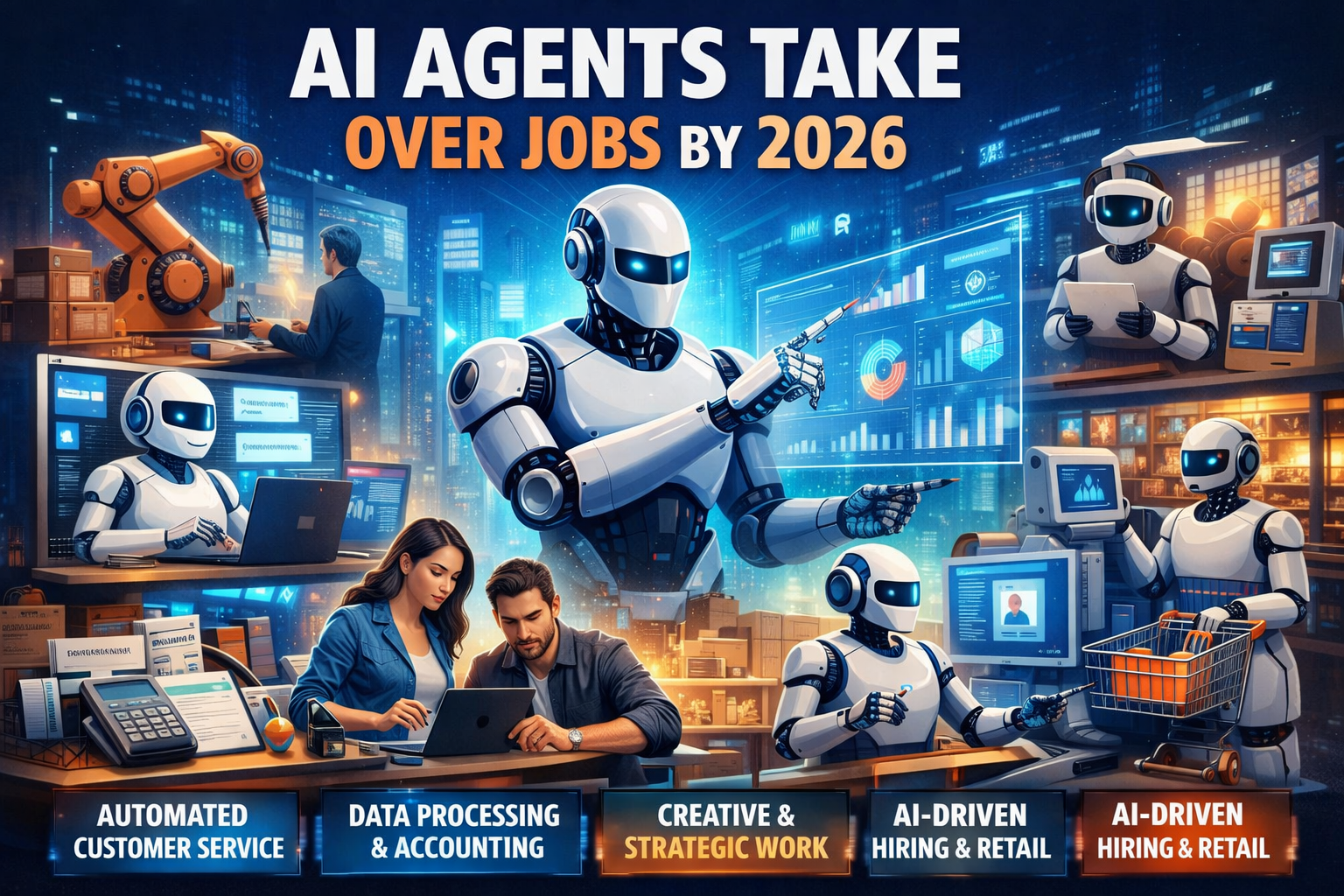
AI Agents Take Over Jobs by 2026
Right now, artificial intelligence works like part of the team. By 2026, smart programs take care of jobs people used to do by hand. Companies depend on them because they get things done faster, spend less money, yet keep performance high.
This change brings up a thought. Could it be that machines aren’t taking roles - but changing what those roles mean instead?
Something in the middle holds the reply. Look close at actual patterns, rely on solid numbers, include everyday situations to see it better.
AI Agents Explained Simply?
Working on their own, AI agents handle jobs without help. These programs decide what to do by looking at information. Learning happens as they go through more examples. Over days or weeks, performance gets better simply because they keep trying.
AI agents beyond basic automation
- Understand context
- Analyze large datasets
- Interact with users
- Take actions without constant supervision
Take tools such as ChatGPT from OpenAI - these function much like digital helpers. Behind the scenes, Google Gemini works in similar ways. Another one, Microsoft Copilot, fits right into that group too. Instead of doing tasks alone, people use these alongside their daily work. Writing messages? That becomes quicker. Creating bits of software code also gets easier. Even organizing complex steps in a job flow changes with support from them.
McKinsey & Company found in 2023 that machines might handle work now done by people - tasks filling up most of their day across various fields. What once took hours may soon run on its own, quietly reshaping routines without noise or drama. Though invisible, these shifts could touch nearly every job in sight.
Businesses Use AI Agents More Often
It's not about following fashion when firms bring in AI. What drives them is the real edge it gives their operations.
1. Cost Reduction
One way machines help? Cutting down staff numbers for routine work. Paying fewer people adds up - less cash spent on paychecks, less stress managing offices.
2. Speed and Efficiency
Every second of every day, machines keep going without slowing down. What once needed many hours shrinks into moments.
3. Scalability
One AI setup serves countless people all at the same time. Not so long ago, workers needed weeks to manage what now happens in seconds. Machines keep going without slowing down. People need breaks, shifts, rest - those limits just aren’t there for software. Speed stays steady no matter how many ask.
4. Data-Driven Decisions
Out of nowhere, patterns emerge when machines sort through information at speed - suddenly, choices get sharper. Because of this, thinking ahead becomes easier.
By 2030, AI might add as much as $15.7 trillion to the world economy - PwC says so. Productivity improvements are behind most of that jump. That kind of growth doesn’t come along every day.
Jobs Being Replaced by AI Agents in 2026
Some jobs face more pressure from artificial intelligence than others. Tasks following strict patterns tend to draw its focus first.
1. Customer Support Executives
Frequently, automated helpers answer people's questions online. Most support tasks go straight to smart programs instead.
- Answer FAQs instantly
- Resolve common issues
- Provide 24/7 support
Some businesses - Amazon, for example - rely on smart software so employees handle fewer routine tasks. Shopify does something similar, using automated tools that take over parts of customer help.
What changed?
Faster than before, people used to sit around waiting - minutes, sometimes even hours. These days? A few seconds is all it takes because machines answer right away.
2. Data Entry and Admin Jobs
Faster than humans, these digital helpers sort through information while making almost no mistakes.
- Automate spreadsheet updates
- Extract data from documents
- Manage scheduling
Robots doing jobs people used to get paid for. Machines now handle tasks start to finish without breaks. Software such as UiPath runs routines overnight. Zapier AI connects apps so they talk on their own. Workflows move forward even when teams go home.
3. Basic Content Writing
AI can now generate:
- Blog drafts
- Product descriptions
- Email campaigns
Still, artificial intelligence falters when it comes to emotion, original ideas, or rich stories. Because of that, it takes over basic writing tasks - never the work of skilled writers.
4. Telemarketing and Sales Outreach
AI agents now:
- Send personalized emails
- Follow up automatically
- Qualify leads
Tools such as HubSpot AI along with Salesforce Einstein handle big chunks of selling tasks without human help.
5. Bookkeeping and Basic Accounting
AI tools handle:
- Invoice processing
- Expense tracking
- Financial summaries
Tools such as QuickBooks AI cut down time spent on number crunching. Xero handles routine tasks without constant oversight.
Jobs Changing With AI
Truth is, AI won’t wipe out every job. Instead, it shifts the way work happens.
1. Marketing Professionals
These days, machines sort through numbers while ads run themselves. People who sell things shift attention elsewhere
- Strategy
- Branding
- Creative direction
2. Software Developers
AI writes code, but developers still:
- Design systems
- Solve complex problems
- Review AI outputs
While GitHub Copilot assists coders, human judgment still guides the work. Though tools speed up typing, they don’t think ahead. A developer stays in charge, even when help arrives mid-line. Machines suggest, yet people decide. Code flows faster now - yet minds shape its path.
3. Designers and Creators
Pictures come from tech such as Midjourney or Adobe Firefly. Yet choices behind them? Those belong to people
- Concept creation
- Brand identity
- Final design decisions
The Human Edge Remains Intact
Though smart, AI agents can only do so much.
1. Creativity
Out of old pieces, AI builds something new. Yet a person dreams up thoughts from nothing at all.
2. Emotional Intelligence
Emotions? Machines can’t feel them. Responses come from patterns, not feelings.
3. Critical Thinking
When details are missing, people still figure things out well. Their minds handle messy scenarios more naturally than systems that rely on full datasets.
4. Ethics and Judgment
Patterns guide how machines behave. What people judge as fair shapes choices instead.
Here’s something Harvard Business Review points out: AI tends to shine brightest alongside human thinking, rather than taking over completely.
AI Taking Over Jobs In Everyday Life
Customer Service Automation
One reason some businesses cut back on staff? They switch to chatbots. By 2026, most customer chats might be with machines - Gartner says around three out of four.
AI in Hiring
Screening resumes? That job now belongs to machines. People once did it by hand - those days are fading fast. Machines pick who moves forward. Human eyes step in later, much later.
AI in retail stores
Cashierless kiosks along with smart stock tracking mean fewer workers behind counters. Machines handling payments while sensors watch supply levels change how stores operate.
The Hidden Truth About Losing Jobs and Creating Jobs
Few jobs vanish when machines learn. Yet fresh paths open just the same.
Jobs Being Created:
- AI trainers
- Prompt engineers
- Automation specialists
- AI system managers
World Economic Forum Future of Jobs Report 2023
83 million jobs may disappear by 2027
69 million new jobs may be created
How fast folks adjust makes all the difference here.
Skills That Matter in 2026
When machines shift how work gets done, staying still isn’t an option. Instead, growth happens by moving alongside them.
1. Learn AI Tools
Start by getting familiar with apps such as ChatGPT. Think about how Notion AI fits into daily tasks. Then there are systems that handle repetitive work - those matter too.
2. Focus On High Value Skills
- Strategy
- Communication
- Problem-solving
3. Build Technical Awareness
Most of the time, heavy coding isn’t required - still, a clear idea of how AI functions helps.
4. Improve Creativity
When machines take over routine tasks, fresh ideas start to matter more.
Business Responses
Stuck in old ways, some businesses find it hard to keep up when machines learn faster. Yet rushing in without thinking brings its own troubles.
Smart Approach:
- Use AI for repetitive tasks
- People work best when focused on big-picture tasks
- Train employees to work with AI
Faster results come through this method, yet future gains stay safe.
Risks of AI Taking Over Human Work
While artificial intelligence offers advantages, difficulties come along with it. Sometimes progress shows two faces at once. New tools help yet bring new problems to solve.
1. Job Displacement
Most likely to be affected are those doing the same tasks again and again.
2. Skill Gap
Most folks haven’t learned how to handle AI tools yet.
3. Over-Reliance on AI
When machines handle most tasks, people might stop paying close attention. Oversight can slip when reliance on automated systems grows unchecked.
4. Data Privacy Concerns
Most times, data piles up fast when machines learn. This buildup? It nudges into personal space without asking first.
Out there, groups such as the OECD plus the World Economic Forum keep pointing to careful AI use. What stands out is how both highlight accountability when rolling out these systems. Noteworthy too - trust matters just as much as function. Behind every call they make lies a push for balance. Seen differently, progress shouldn’t come at ethics’ cost. Their stance? Move forward - but watch each step.
What Comes Next?
Still, AI agents keep changing. Actually, their abilities grow stronger over time.
Expect these details next
- More autonomous systems
- Better natural language understanding
- Deeper integration into business workflows
Yet clarity holds firm here
Computers won’t take every job. Yet those who ignore change might lose theirs.
Final Thoughts
By now, artificial intelligence systems have taken over roles once done by people. These digital helpers complete routine work quicker, at lower cost, yet still with precision.
Still, things aren’t just getting worse. This change nudges folks into jobs that matter more - where thinking, making, and planning take the lead.
The key is simple:
- Learn AI
- Work with AI
Blind competition gets you nowhere
Picture AI like a hammer, something you learn to hold. Those who see it that way will shape how jobs evolve. Not because they fear it, but because they use it without drama.
Sources
- Generative AI’s economic impact according to McKinsey 2023
- PwC – Sizing the Prize: What’s the Real Value of AI for Your Business?
- World Economic Forum – Future of Jobs Report (2023)
- Gartner – Customer Service and Support Predictions
- Harvard Business Review – Collaborative Intelligence: Humans and AI Are Joining Forces